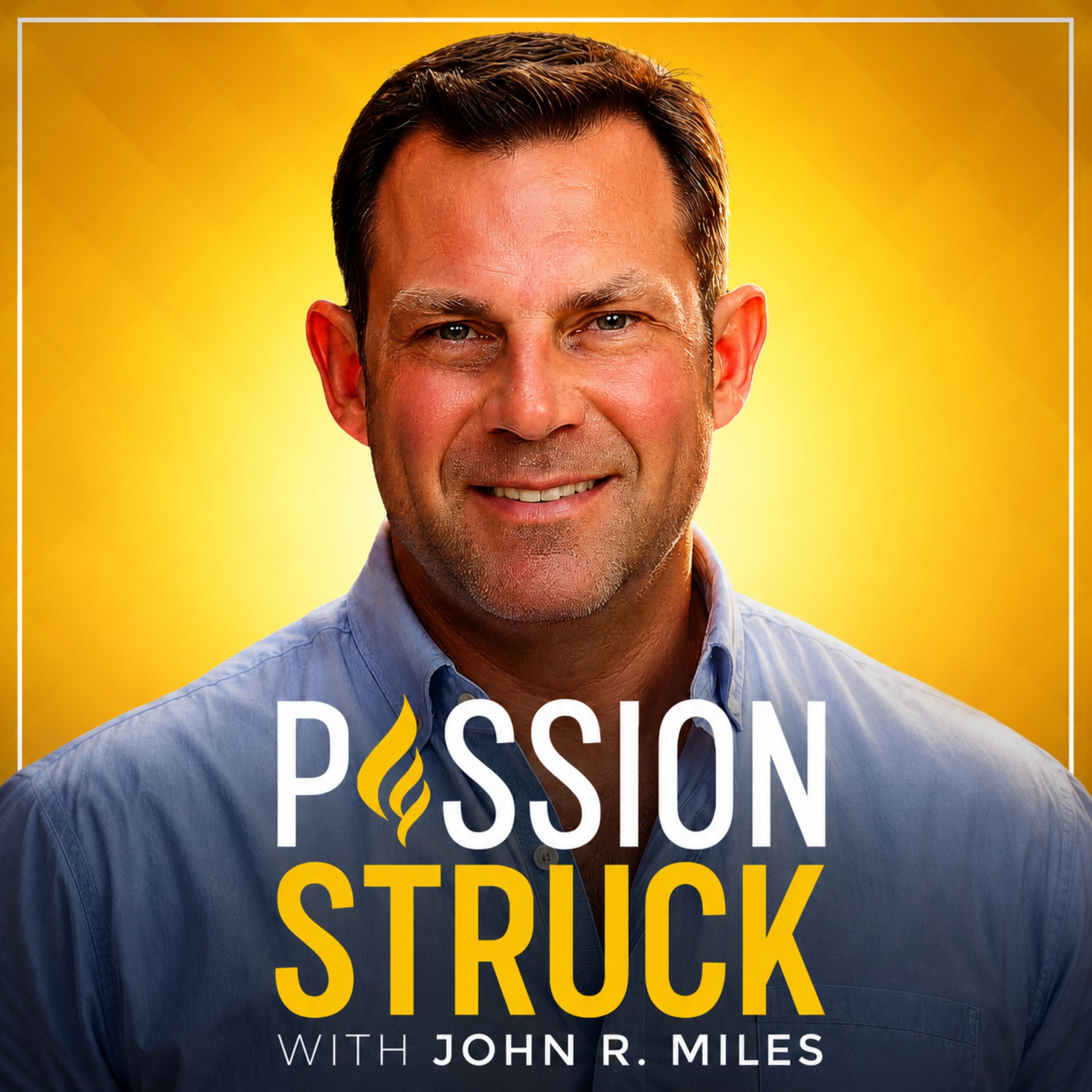
Pod Insights Passion Struck with John R. Miles The Identity Gravity Trap: Why We Snap Back to Old Habits | John R. Miles - EP 759 About this episode Does the silence of a new life feel like a threat to your safety? You’ve finally walked through the threshold, but the "silence" starts to itch. Suddenly, you feel a physical, vibrating urge to go back to being the "Fixer"—the version of you that is useful, busy, and predictable. That urge has a name: Identity Gravity. In this episode of Passion Struck, John R. Miles explores the "Architecture of the Interior" and the psychological forces that pull us back into old orbits. Drawing on the external market systems discussed with Nobel Laureate Alvin Roth, the psychological flexibility frameworks of Dr. Diana Hill, and the raw "Identity Bankruptcy" of TOMS founder Blake Mycoskie, John explains how to achieve escape velocity. This is a deep dive into the neurobiology of the Default Mode Network (DMN) and the "Moral Economics" of the self. It’s time to stop being a tool for someone else’s convenience and learn how to break the identity gravity trap. Passion Struck is the #1 personal growth podcast dedicated to human flourishing and the science of mattering. Check the full show notes here: https://passionstruck.com/how-to-break-identity-gravity/Explore the Identity Gravity Audit for this episode at: https://www.theignitedlife.net/p/how-to-break-identity-gravity-trapThank You to Our Sponsors. Limited Time Offer – Check out Function Health—160+ lab tests a year for $365. Join at https://www.functionhealth.com/tcm/passion or use gift code PASSION25 for a $25 credit toward your membership. Connect with John Keynotes, books, podcast, and resources: https://linktr.ee/John_R_Miles Children’s Book — You Matter, Luma: https://youmatterluma.com/Pre-Order The Mattering Effect: https://matteringeffect.com/In this episode, John discusses:The Physics of the Snap-Back: Why your brain treats stillness like a biological threat and how "identity gravity" pulls you back to the grind. The Static of the DMN: Understanding why high-performers suppress the Default Mode Network and why its "re-boot" feels like anxiety instead of peace. Identity Bankruptcy: Lessons from Blake Mycoskie on the "gradual disappearance" that happens when your utility replaces your identity. The Repugnant Transaction of Being: Why sitting still feels like a moral betrayal when you’ve internalized a market that only values "doing."The Commoditized Human: Breaking the feedback loop that turns you into an interchangeable tool rather than an essential presence. The Boundary ADR: Using "Architectural Decision Records" to protect your time and reclaim the monopoly of your own presence. Achieving Escape Velocity: The three pillars of architectural rigor needed to break the snap-back effect and stay in your new orbit. Support the Movement: https://StartMattering.com Every human deserves to feel seen, valued, and like they matter. Wear it. Live it. Show it. DisclaimerThe Passion Struck podcast is for educational and entertainment purposes only. The views and opinions expressed do not necessarily reflect those of Passion Struck or its affiliates. This podcast is not a substitute for professional medical or...
Transcript Speaker names marked ? are inferred from speaking time and the show’s known hosts — they are not voice-verified.
0:00 John R. Miles? Coming up next on Passion Struck, you did it. You finally walked through the door. You put the phone in the drawer. You stood still in the hallway and for 60 seconds felt the floor beneath your feet. But then the silence started to itch. Your brain began triaging the unread emails you haven't sent. You felt a physical vibrating urge to go back to being the fixer, the person who manages, handles, and produces. That urge has a name. I call it identity gravity. Think of it as the psychological tether of your old self. It's the invisible force that tries to pull a changing person back into an old orbit
0:44 John R. Miles? because your nervous system and the people around you are comfortable with the version of you that is useful, even if that version is exhausted. Today, we aren't just stepping through the threshold. We are learning how to achieve escape velocity. It's time to stop being a tool for someone else's convenience and start being the architect of your own significance. Welcome to Passion Struck. I'm your host, John Miles. This is the show where we explore the art of human flourishing and what it truly means to live like it matters. Each week, I sit down with changemakers, creators, scientists, and everyday heroes to decode the human experience and uncover the tools that help us lead with meaning,
1:27 John R. Miles? heal what hurts, and pursue the fullest expression of who we're capable of becoming. Whether you're designing your future, developing as a leader, or seeking deeper alignment in your life, this show is your invitation to grow with purpose and act with intention. Because the secret to a life of deep purpose, connection, and impact is choosing to live like you matter.
1:55 John R. Miles? Hey friends, welcome back to Passion Struck. This is episode 759, and we're deep in the Purpose by Design series. Where the last few weeks, we have been building the foundation for life that actually matters. We started this solo series by diagnosing why so many of us are winning the wrong game, playing an invisible scorecard that prioritizes responsiveness over intentionality. Then, we ran the numbers on the ROI of aliveness. Realizing that your real wealth isn't in what you produce, but in how much life you actually experience. Last week, we went to the hardest place of all: why we circle change. We looked at the fear that keeps us sitting in the driveway, staring at the front door,
2:38 John R. Miles? unable to move from being a provider to being a presence. But here is the reality of the threshold. Crossing it is only half the battle. Staying on the other side is where the real design begins. Earlier this week on Tuesday, I sat down with Nobel laureate Alvin Roth to discuss the moral economics of our lives. We explored how the systems we live in, the markets of our careers and families, are designed to coordinate our behavior, often in ways that trade our autonomy for utility. And yesterday, I was joined by Dr. Diana Hill to talk about her book Wise Effort. She challenged us to look at the unwise efforts we make,
3:22 John R. Miles? the energy we waste avoiding discomfort or clinging to the old stories that no longer serve us. When you connect these dots, the external market systems of Al Roth and the internal psychological flexibility of Diana Hill, you realize that your life is currently designed for utility instead of significance. We are held back by identity gravity, which I mentioned a few moments ago. It's the pull of a life that was built to use you rather than a life that was built to express you. In this episode, we're going to look at the architecture of the interior. We'll explore the identity vacuum, why the silence of a new New life feels like a physical threat to your safety.
4:05 John R. Miles? The market of you ought to stop being a commodity in your own relationships and start being an essential presence. And lastly, achieving escape velocity, the specific design shifts required to break free from the snapback effect and stay in your new orbit. If you're tired of feeling like a rocket that keeps falling back to earth, this episode is for you. Share this with a high performer who is currently fighting their own gravity. And while you're at it, head over to Apple Podcasts or Spotify to leave us a review. It's the single best way to help others find this mission. And lastly, if you'd prefer to watch this, go to our YouTube channels at John R. Miles or Passion Struck Clips. You've crossed the threshold. Now it's time to design the room.
4:51 John R. Miles? Thank you for choosing Passion Struck and choosing me to be your host and guide on your journey to creating an intentional life that matters. Now let's break the gravity and let the journey begin.
5:07 John R. Miles? Let's be honest about what happens when you decide to change. You've heard me talk about the car engine dying in the driveway, but I wanted to talk about the engine inside you that refuses to shut off. When you decide to stop being the fixer, when you decide to finally inhabit your life instead of just managing it. You aren't just making a schedule shift. You are fighting millions of years of evolution. Your brain sees stillness as vulnerability. In the wild, if you stop moving, you're prey. In the modern office, if you stop responding, you're replaceable. This creates a physical sensation I call identity gravity.
5:51 John R. Miles? It's the heavy laden feeling in your gut that tells you that if you aren't being useful, you aren't safe. To understand why you can't stay changed, we have to look at the neurobiology of the default mode network or the DMN. In neuroscience, we talk about two primary systems. First, there's The task positive network. This is your fixer brain. It's the part of you that triages emails, manages the kid's soccer schedules and hits deadlines. High performers live in the task positive network. We are addicted to it because it provides a steady drip of dopamine every time we complete a task. The second system is the default mode network.
6:37 John R. Miles? This is the seat of the self. It's the system designed for daydreaming, self-reflection, memory consolidation and moral reasoning. It is the part of your brain that asks, who am I? And does this matter? Here's the problem. High performers have trained their brains to suppress the default mode network. For decades, you have treated self-reflection as an enemy of efficiency. When you're under chronic stress, your body is flooded with cortisol. And science shows us that high levels of cortisol actually decrease the connectivity in your default mode network. In human performance and behavioral psychology, a snapback, often referred to as the rubber band effect,
7:22 John R. Miles? is the phenomenon where an individual attempts to make a significant life or identity change, only to find themselves pulled back into their old patterns, habits or self-image. It's the gap between the insight of knowing you need to change and the sustained integration of actually living that change. So where that comes into application here is the snapback isn't about rest being threatening to your brain. It's the opposite. Because your default mode network has been dormant or suppressed for so long. When you finally sit still in that driveway, the system tries to reboot. But after years of neglect, that reboot feels like static. It feels like anxiety.
8:07 John R. Miles? It feels like a vacuum. And here's what most productivity obsessed people miss. The vacuum is the default mode network trying to ask you questions. Questions like, who are you without the output? What matters? To you, not to your boss, not to your kids, but to you. These are the questions your brain has been postponing for decades. And when the silence comes, the questions arrive like unpaid bills. And they are terrifying. Your brain hasn't forgotten how to make meaning. It's just terrified to start. I was reminded of this just yesterday when I sat down with Blake Mycoskie, the founder of TOMS.
8:51 John R. Miles? On the outside, Blake was the gold standard of purpose. He built a billion dollar company based on giving. He had meaning on every balance sheet. But Blake shared something profound with me. He described it as gradual disappearance. Not depression, not initially, but a slow erasure. Year after year after year. The question, who is Blake? Got answered by Blake is the guy who gives shoes. The personal pronouns started to disappear from his own internal monologue. He stopped being a person who did something and started being a function. By the time he sold the company at the peak of its success, he realized no one had ever met Blake.
9:35 John R. Miles? They'd only ever met his utility. Blake had constructed an identity debt so massive that when the company sold, he didn't experience relief. He experienced collapse. He borrowed against his future self for two decades. The bill came due. The moment the task positive requirements of being a CEO disappeared. And he was left alone with the person he'd neglected to build. He was the fixer for millions of people around the world. But he was a stranger to himself. He had to learn how to break the gravity of being a super producer to find the man who actually lived inside the suit.
10:18 John R. Miles? This is where the work of Nobel laureate Al Roth becomes so essential. In his research on market design, Al talks about repugnant transactions. Things that society could do, but we find more. Morally suspect. We could sell kidneys to the highest bidder. It's economically efficient, but we find it repugnant. Why? Because something in us rejects the idea of reducing a vital organ to a commodity. For the high performer, presence occupies the same moral space. You could rest, you could be still, you could listen to your own breath, but something in you rejects it as repugnant, as a betrayal of your obligation to be useful.
11:02 John R. Miles? When you sit on your porch without a laptop, a voice in your head screams that you are doing something wrong. You've internalized a moral market where being has zero value and doing is the only currency. That's not weakness. That is a market you've designed for yourself. Breaking identity gravity requires more than a new routine. It requires a noetic shift, a term Dr. Diana Hill used in our conversation yesterday. It's a total shift in perspective. You have to realize that the itch you feel in the silence isn't a signal to get back to work. It's the sound of your meaning-making brain, your default mode network, trying to breathe again.
11:48 John R. Miles? You weren't sitting in the driveway because you're stuck. You're sitting there because you are at the edge of your own atmosphere. And the only way to get to the other side is to stop feeding the engine that kept you on the ground. I want you to really hear this. Insight is just a map. You can understand the physics of the snapback. You can recognize the dormant systems in your brain. You can know exactly why you feel like an invisible man or woman in your own life. Just like Blake described, and still not move an inch toward the door. This is exactly why I created The Ignited Life. The core of this Purpose by Design series is the belief that significance isn't a destination you stumble into.
12:31 John R. Miles? It's an environment you build through intentional reflection. But you cannot build that environment if you won't stop long enough to ask the questions that actually move the needle. For this episode, I put together A companion identity gravit audit on Substack. It's a specialized tool designed to help you see exactly where your identity depth is being called in and how to start redesigning the market of your life. Because insight creates awareness, but reflection creates direction. It's time to stop being a tool for someone else's convenience and start being the architect of your own significance. Join the conversation and get the audit at the unitedlife.net. Now, a quick break for our sponsors. Thank you for supporting those who support the show.
13:15 John R. Miles? You're listening to Passion Struck right here on the Passion Struck Network. Now, come back to that threshold with me. We've talked about the physics. We've talked about how your brain treats stillness like a biological threat. But there's a deeper structural reason why it's so hard to stay changed. There's a reason you feel so replaceable the second you stop moving. It's because you have allowed yourself to become a commodity. In the world of economics, a commodity is a hammer. If one hammer breaks, you don't mourn it. You just go to Home Depot and buy another one that performs the exact same function. The reason you feel the identity gravity pulling you back to your desk so strongly is because you've spent your whole life winning a game designed to turn you into an inventory
14:00 John R. Miles? item. You have anchored your entire sense of worth to your utility. You are the guy who gets it done. You are the woman who never says no. But here is the trap. The more useful you are as a tool, the more replaceable you are as a human. To understand why this is so hard to break, we have to look at the work of Nobel laureate George Akerlof and Rachel Kranton. They pioneered a field called identity economics, which shows us that our sense of self is actually the primary driver of our behavior. They call this the identity utility feedback loop. The more your identity becomes the fixer, the more every choice you make reinforces that utility.
14:44 John R. Miles? That makes you more replaceable as a commodity, which in turn makes you feel more insecure, which makes you cling to the fixer role even tighter just to prove you matter. It's a self reinforcing cycle of disappearance. This leads us back to a concept Al Roth calls repugnant transactions.
15:03 John R. Miles? As I explained earlier, these are the things that might be economically efficient, but we find them morally suspect, like selling a kidney. For the high performer, presence occupies the same moral space. You could rest, you could be still, you could listen to your own breath. But because your identity is so tied to being useful, something in you rejects stillness as repugnant, as a betrayal of your obligation to produce. So when you sit on your couch, watching TV, a voice in your head screams that you should be doing something else, and what you're doing is wrong. You have internalized a moral market where the act of being without doing is a violation of your own internal rules.
15:47 John R. Miles? This is why you snap back. You weren't just busy, you are a fixer who feels morally compromised when they aren't fixing. To break the gravity, you have to stop seeing your aliveness as a waste of time and start seeing it as the only asset you have that cannot be replaced.
16:07 John R. Miles? If we have diagnosed the physics of why you snap back and the economics of why you feel replaceable, then we have to talk about the architecture. This is where we stop talking about the trap and start talking about the room you're actually going to live in. I want to bring in a concept from my conversation yesterday with Diana Hill. It's called wise effort. Now, I know my audience. You worship effort. You think more grit, more sweat, and more grind is the answer to every problem. But Diana argues that most of us are trapped in what she calls unwise effort. We are spending massive amounts of energy on things that actually reinforce our own identity gravity.
16:51 John R. Miles? In the architecture of your new life, you have to dismantle three specific traps. I want you to listen closely, because you're probably doing at least one of these right now. Diana's first task is to get curious. But the fixer? The fixer avoids curiosity like the plague. Why? Because Curiosity is dangerous. If you get curious, you might realize you aren't actually indispensable. Think about the personal texts you haven't answered yet. You tell yourself you're too busy, but the truth, you're avoiding it because answering would prove you have the time. It would shatter the myth of the super producer.
17:33 John R. Miles? You are using your busyness as a shield to avoid being human. The second task is to open up, but instead we cling. We cling to our over-functioning. You've told your family you're present, but you're still checking the project management software at 10:00 PM. You're gripping the commoditized self, the version of you that is useful because the essential self feels like a free fall. You're terrified that if you let go of the machine, there won't be a person left underneath. And this brings us to the third task, which is focus. But instead, we choose hustle. This is the noise we use to fill the vacuum of the default mode network reboot we talked about earlier.
18:17 John R. Miles? We let busy pebbles bury the big rocks of our lives. We run so we don't have to face the question, who am I when I'm not being a tool for someone else's convenience? This is the noetic shift we talked about earlier. A fancy way of saying a total change in how you see. Most people try to change their actions. They try to act present, but purpose by design requires you to change your vision. You have to look in the mirror and realize that the fixer isn't a hero. It's a social construction you've been using to hide. Now, I want to give you a radical piece of permission. You have to learn to be useless.
18:59 John R. Miles? I know that feels like a repugnant transaction, but in the architecture of your soul, transactional uselessness is the only way to find relational significance. Think about Blake Mycoskie. He had to stop the meaningless hustle of global philanthropy to find the man who was enough without the brand. He had to stop hiding behind the shoes and start. Facing the man, he moved from avoidance to curiosity. He stopped proving he mattered and started living like he mattered. If you're able to, I want you to take out a piece of paper and a pen. I want you to draw a line down the middle of a page. On one side, write labor. On the other side, write presence.
19:45 John R. Miles? Labor is a commodity. Think of it as your utility. It's what can be replaced by an AI or a younger fixer in 30 days. Presence is a monopoly. It's what Diana calls capital L, love. It's your vitality. It's the unique constellation of your attention that cannot be replicated. Your new interior architecture is built on your ability to sit in the static. It's built on the courage to say, I'm not answering that email right now. Not because I'm too busy, but because I'm occupied with the monopoly of my own presence. So throughout today's episode, we've diagnosed the physics, the economics and the psychology.
20:31 John R. Miles? Now we move into the actual design phase. If you're going to break the snapback effect, you cannot rely on willpower. Willpower is a battery that runs out. You have to rely on architectural rigor. In physics, escape velocity is roughly 11.2 kilometers per second. But here's the catch. It requires sustained thrust. If the rocket stops firing its engines too early, gravity wins every single time. Your life is no different. To stay in your new orbit of presence, your flight plan requires three specific pillars to keep those engines firing. The first pillar is the boundary ADR.
21:12 John R. Miles? Now, many of you who are regular listeners know that I spent the first half of my career leading tech organizations. In software engineering, we use an ADR, an architectural decision record. It's a documented choice that explicitly lists the trade offs. I want you to create a mental ADR for your grand 找出你回 utility 模式 识别出你回 utility 模式 或应用 让你回到 utility 模式 你的记录说 我明天早上会提供我的耳朵 但今晚不会 所以你必须诚实 折返是短期的不适 但你正在做出 documented 选择 reclaim 你自己的权衡 第二层是 structural sovereignty
21:57 John R. Miles? 如果你想了解更多关于这个 我建议你回到我的与我的朋友 埃米斯·萨佩拉 防止你缓慢地回到成为工具 你的生活需要三个支持 这构成了 structural sovereignty 第一, dissent 对传统的系统毫无帮助的极端勇气 第二, sovereignty 把你的时间视为非 renewable 资源 第三, kinetic kindness 这是 passion struck 使命的一部分 这不是 caretaking 因为压力而发生的 它是在与某人一起移动 它是在 provision 到 presence 最后一层是我想叫的 daily burn 在 spaceflight
22:41 John R. Miles? 你必须定期发动引擎 保持在轨道 布莱克·麦克科斯基分享了 他的 enough movement 的力量 对于他来说,简单的手环 可以作为 semantic 铅轨 每次他触摸它 它触发了 neural pathway intentionally 短路 旧 utility 循环 并提醒他他没有 output 你需要自己的 protocol 来做 daily burn 首先,你需要感受你的身体的 literal 重量 种植你的脚 然后你需要做 deep diaphragmatic breaths 来告诉你的神经系统 就是三个 然后最后,你需要做 default mode network check-in 你需要问自己 我为什么不是有用的
23:27 John R. Miles? architecture 只有 建筑师的 willingness 去占领空间 你可以用纸笔描绘最美的 intentional 生活 但如果你不愿意忍受静寂的 vacuum 如果你不愿意让 fixer 死亡 所以人类 Can breathe, then you're just rearranging the furniture in your own prison. Blake Mykowsky had to decide that Blake the human was more important than Blake the founder. You are standing at that same threshold. This week, stop trading your monopoly for a commodity. Break the loop because the world doesn't need more fixers. It needs people who have achieved escape velocity and are finally living in the life they were designed for.
24:09 John R. Miles? Tonight, when you walk through that door, don't scan for what needs to be fixed. Just stand still, feel the floor beneath your feet. Remind yourself, I am the person who lives here. I'm not just the person who maintains the structure. So just stand still, feel the floor beneath your feet. Remind yourself, I am the person who lives here. I'm not just the person who maintains the structure. That act of standing still, of reclaiming your own presence is the foundation for everything else. Because once you find yourself again, you can finally begin to find others. And that is exactly where we're going next week. Because if today's episode is about how we direct our internal energy.
24:54 John R. Miles? Next week, we explore something just as essential, how we connect. I'm joined by University of Chicago psychologist Nicholas Epley. At the core of Nick's work is a powerful paradox. We are a deeply social species wired for connection, and yet every single day. We choose to be less social than we could be. We avoid the stranger, we stay in small talk, we hold back the appreciation we feel. In this conversation, we explore why our expectations about others are often overly pessimistic. And how choosing connection can transform your life. You won't want to miss it.
25:28 Speaker 01 We tend to think about ourselves in terms of our competency. Right? So you're thinking about starting a conversation, you think, well, what are we going to talk about? Do I have anything in common with this person? Can I carry it on? Right? You're an agent. You're thinking about your competency. Okay? Other people, they care about your competency, but not first and foremost. What they first and foremost care about is how nice are you? That's the basic, how warm are you? Are you friendly? Are you trustworthy? Are you afraid? Friend I can interact with or you a foe, somebody I should avoid. So we're evaluating ourselves through this lens of competency. Other people are evaluating us through this lens of warmth. When you reach out to engage with somebody positively, those are inherently warm acts. Those are going to be high on that spectrum, on the warmth spectrum.
26:11 Speaker 01 People are going to react to that generally pretty positively.
26:15 John R. Miles? If this episode resonated with you, please share it with someone who might be feeling misaligned in their own utility trap. Take a moment to leave us a five star rating or review on Apple Podcasts or Spotify. It's how we reach more people with this mission. And make sure you explore more tools, including the Identity Gravity Audit at theignitedlife.net. Until next time, remember, purpose isn't just about what you choose. It's about how you direct your energy toward it. I'm John Miles and you've been passion struck. Lead with energy, act with wisdom, and as always, live your life passion struck.
Previous How to Manage Energy Not Time: Dr. Diana Hill on Wise Effort | EP 758 Next If You Feel Lonely, Listen to This: How One Conversation Can Change Your Day | Nicholas Epley - EP 760 Page updated October 30, 2026 · transcript and summary are machine-generated