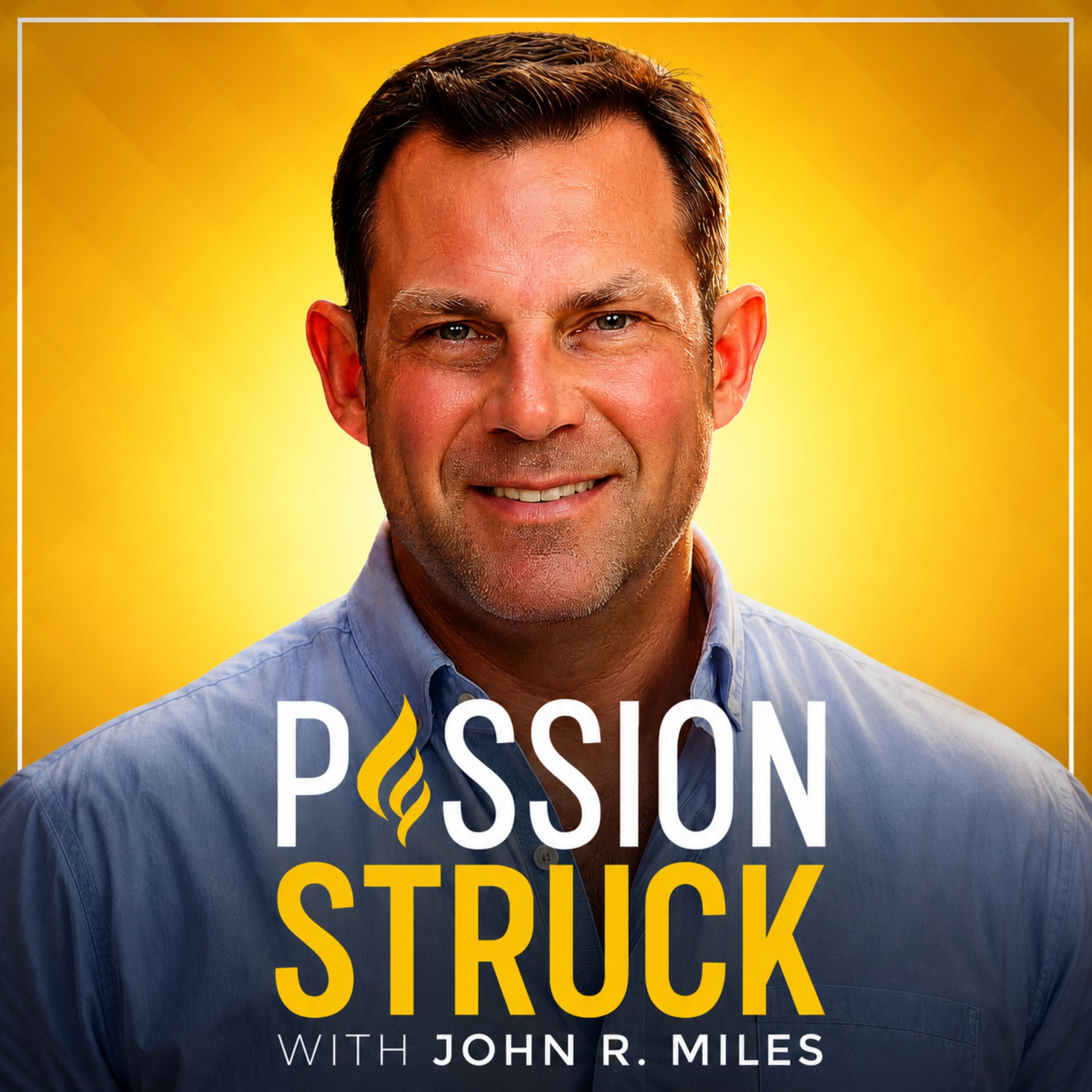
Pod Insights Passion Struck with John R. Miles How to Find Meaning When Life Doesn't Go as Planned | John R. Miles - EP 774 About this episode What if the hardest parts of your life weren't something to move beyond—but something to build from? In this solo episode, John R. Miles explores how small acts of contribution, gratitude, and courage can transform pain into purpose and help you create a legacy that outlives your struggles.
Transcript Speaker names marked ? are inferred from speaking time and the show’s known hosts — they are not voice-verified.
0:00 John R. Miles? Coming up next on Passion Struck, if you look closely at that quiet scene in the prison office, you see a man slowly rolling a single sheet of paper into a typewriter. Outside his window are the cold stone walls of Shawshank State Penitentiary. He's been stripped of everything, his career as a banker, his freedom, his identity. Yet, instead of planning a loud rebellion, he spends his energy typing a simple letter to the state legislature, asking for a small donation of books, books he might never live to see. It makes you wonder why someone fighting for his own survival would spend his limited energy on something that looks so small to the world around him.
0:44 John R. Miles? It's because Andy Dufresne understood something we often miss. True transformation doesn't stop at saving yourself. Our deepest struggles were never meant to be private secrets. They are the exact place where our lives learn to turn outward, moving from individual survival to a quiet, shared significance. Welcome to Passion Struck. I'm your host, John Miles. This is the show where we explore the art of human flourishing and what it truly means to live like it matters. Each week, I sit down with changemakers, creators, scientists, and everyday heroes to decode the human experience and uncover the tools that help us lead with meaning,
1:25 John R. Miles? heal what hurts, and pursue the fullest expression of who we're capable of becoming. Whether you're designing your future, developing as a leader, or seeking deeper alignment in your life, this show is your invitation to grow with purpose and act with intention. Because the secret to a life of deep purpose, connection, and impact is choosing to live like you matter.
1:53 John R. Miles? Hello, friends, and welcome back to episode 774 of Passion Struck. We're closing out our month-long "Forged in Adversity" series. Over the past three weeks, we've traced what happens when life breaks us open. We started on that isolated shoreline, watching our... External identities get washed away. We examine the armor we build for protection and how it can slowly become its own kind of prison. Last week, we stepped into the alchemical fire and explored the difference between simply patching up the old self and allow something deeper to take shape. This final episode in the series is about where the journey ultimately leads. Contribution.
2:34 John R. Miles? The moment when what we've gained in the darkness begins to move outward and touch other people. Earlier this week, I spoke with Eric Zimmer, host of The One You Feed. Eric shared the quiet power of small, consistent actions and how they compound without burning us out. I also sat down with Walter Green, former CEO and founder of the Say It Now Movement. Walter spoke with real honesty about the three chapters of a meaningful life and why we so often wait until it's too late to tell people how much they matter. Both conversations carried the same quiet message. Significance isn't something we hold on to for ourselves. It's something we learn to pass along.
3:16 John R. Miles? In today's episode, we'll explore how that shift happens through small, steady steps, even in difficult places, through the natural seasons of a life, through the simple but powerful act of telling people while they're still here exactly how they made a difference. To understand this, we're going to look directly at the narrative of the prison library, the biology of why our minds resist massive changes, and how we can use the power of quiet specificity to break through the isolation that lines our daily lives. Now let's get into it. Thank you for choosing Passion Struck and choosing me to be your host and guide on your journey to creating an intentional life that matters. Now, let that journey begin.
4:02 John R. Miles? There's a quiet trap many of us fall into when we finally feel ready to grow or give something back. We've been raised in a world that celebrates big, dramatic change. We wait for the perfect moment, the cleared calendar, the financial cushion, for the feeling that we finally arrived. Only then... We tell ourselves, will we start showing up more fully for our community or the people we care about? So we attempt these massive overhauls and then wonder why we burn out so quickly and find ourselves starting over again. Andy Dufresne faced an environment built almost entirely on resistance. No budget for books, a warden who didn't care, a system designed to slowly crush hope.
4:44 John R. Miles? He could have staged some dramatic protest or demanded sweeping change. Instead, he did something much simpler. He wrote one single letter each week to the state legislature, asking for a small donation of books. Eric Zimmer helped me see why this approach is so wise. Our brains are wired to conserve energy and protect us from anything that feels like sudden overwhelming demand. When we push for huge shifts all at once, our minds treat it as a threat and start shutting down. That exhaustion we feel isn't usually a lack of discipline. It's a natural response to too much friction. What Andy understood was the power of choosing something small enough that resistance couldn't easily stop it.
5:29 John R. Miles? One letter a week didn't require heroic effort, but week after week, month after month, through the long stretch where nothing visible seemed to be happening, those letters kept going out. Eventually, the legislature sent a small check and a few boxes of books just to make him stop writing. And what did Andy do? He immediately started writing two letters a week. That is how quiet contribution often grows, not through grand gestures, but through small, steady actions repeated in the same direction over time. To understand where all those small, steady steps are ultimately meant to lead, it helps us to look at the longer journey of a life.
6:10 John R. Miles? Walter Green described it as three chapters most of us move through: knowing yourself, making yourself, and becoming yourself. The first chapter, knowing yourself, is often messy and uncertain. It's the time of youth and adolescence when you're trying to figure out who you are while carrying early wounds. Family move. And losses that never got properly named. Walter lived this deeply. He lost his father at seventeen. His family moved through thirteen different cities. And he grew up in a home where emotions were kept quiet to protect everyone's fragile health. The second chapter, Making Yourself, is where many of us spend the majority of our adult years. This is the season of building, proving, and climbing.
6:55 John R. Miles? You focus on career, financial security, titles, and results. Before prison, Andy Dufresne lived fully in this chapter. As a vice president at a major bank, he measured his days by professional scoreboards and external success. The difficulty is that a lot of people never leave this making chapter. They reach positions of real achievement, yet still feel strangely empty. Walter knew this feeling well. He built and ran a large national company with over a thousand employees. From the outside, it looked like the pinnacle of success. But he came to see how lonely the top can actually be.
7:37 John R. Miles? The third chapter, Becoming Yourself, asks something different of us. It's the quiet turning point where you step off the constant scoreboard. You realize your worth isn't measured by what you produce or how useful you are. Instead, you begin taking the wisdom, resources, and perspective you've gathered and start directing them outward. You use what you've learned to help other people feel seen, supported, and reminded that they matter. This is exactly the pivot Andy Dufresne made in Shawshank. He stopped using his skills just to survive or protect himself. He began building something for others. He turned part of the library into a schoolroom.
8:21 John R. Miles? He spent years mentoring a young inmate named Tommy, helping him earn his GED. And in one of the most memorable moments, he locked the guards out of the office so he could play a Mozart record over the prison loudspeakers, giving every man in the yard a brief reminder of beauty and humanity. In that hard place, Andy took his own hard-won freedom and began offering it to the men around him. To truly step into that third chapter of becoming yourself, we have to face one of the quieter tragedies in how we relate to each other. Think back to the last funeral you attended.
9:02 John R. Miles? Remember the depth of emotion in the room, the stories people shared, the way tears flowed as they finally spoke about how much that person had meant to them. Our culture has taught us to save those words for the eulogy. We wait until someone is gone before we express the full weight of their impact on our lives. We leave our deepest gratitude unspoken while they're still here, locked away like a gift we never quite deliver. Walter Green's Say It Now movement grew directly out of this realization. It's a gentle but powerful push to shine a light on our relationships while people can still feel the warmth of it. There's a real difference between a general kind word and something much more specific.
9:46 John R. Miles? Saying "I love you" or "You're a great friend" carries warmth, but it doesn't land with the same force. What truly reaches someone is when you get specific, when you take the time to name the exact moments, the particular advice, or the quiet acts of support that made a difference. When I spoke with Walter, it stayed with me. It made me think about Keith, a teammate from high school. Keith was a very gifted runner, a state champion, who went on to become a collegiate All-American. I was a sophomore at the time, just going through the motions and carrying a lot of self-doubt. Keith took me under his wing. He didn't just push me to run faster. He showed me what real effort and pride looked like.
10:29 John R. Miles? He taught me about discipline, about caring deeply, and about believing I could become a better version of myself. For years, I carried the memory of what he gave me, but I never picked up the phone to tell him exactly how much his presence had shaped me. When you sit down and offer that kind of specific appreciation, you're handing the other person a clear mirror. You're showing them moments where their life mattered, often moments they themselves may have long forgotten. It costs us almost nothing, takes very little time, yet it can change the emotional landscape for both of you in ways that linger. So that begs the question, how do we actually begin moving from refinement to contribution in our everyday lives?
11:14 John R. Miles? The simple truth is, you don't need a big platform, perfect timing, or a grand mission. You start small, close to home. Here are three simple shifts that can help you turn outward in a way that feels sustainable. First, begin with one person. The temptation is to wait until you have more time, more energy, or a clearer plan. But waiting usually means doing nothing. Pick just one person whose presence once made a real difference in your life. It might be a mentor, a friend, a teacher, or a family member. Keep it to one. Don't overcomplicate it. Give yourself 30 minutes to sit down and write or prepare what you want to say. That small boundary keeps resistance low
11:57 John R. Miles? and makes the action feel doable. Second, speak with real specificity. This is where the power lives. Skip the general compliments. Instead of saying, "You're great," or "Thanks for everything," tell them exactly what happened. Describe where you were at the time, what season of life you were struggling through. Share the specific thing they did or said, and then explain how that moment stayed with you and shaped who you became. When I thought about Keith after my conversation with Walter, that's what stood out. It wasn't enough to say he was a good teammate. I needed to tell him how lost I felt as a sophomore, how he took time with me anyway,
12:41 John R. Miles? and how the way he carried himself still influences how I show up today. That level of detail turns a nice sentiment into something the other person can actually feel. It hands them a clear mirror of their own impact. Third, let go of needing a particular response. This part can be the hardest. Some people will be deeply moved. Others might feel awkward, stay silent, or respond briefly because they don't know what to do with that kind of honesty. And that's okay. The value isn't in collecting validation back. The victory is in the act of giving it. It strengthens your own sense of meaning and self-trust. And if life gets busy and you drift away from this practice for a while, Eric Zimmer's
13:26 John R. Miles? approach offers a kind way to return. Instead of criticizing yourself, simply notice what happened without turning it into a story of failure. Look at the context. What was pulling your attention or energy? Meet yourself with compassion. Then pick one small next step and begin again. Progress doesn't require perfection. It only asks for gentleness and consistency. This is what Andy Dufresne did so beautifully at the end of his journey. He didn't just escape for his own freedom. He left Red a single, specific letter, hidden under a black volcanic rock in a hayfield in Buxton. No pressure, no expectations, just honest hope and a clear invitation.
14:11 John R. Miles? That one quiet act became the lifeline that helped pull Red out of his own isolation and gave him the courage to keep going. The truth about your past is that it cannot be rewritten. You cannot optimize it away or outrun it through performance alone. The seasons of isolation, the sudden collapses, the long nights in your own versions of confinement, that is the only material you truly have. But you get to decide what it means. You can keep polishing old armor, mistaking rigidity for discipline and distance for strength. Or you can let the heat of what you've lived through melt those protections, freeing the
14:52 John R. Miles? energy to move outward into contribution, into real connection, into something that serves more than just yourself. This is where the forged and adversity journey finds its completion. Not when you feel perfect. But when you began turning what you carried into something that helps others, you're less alone. One small letter, one honest conversation, one specific word of gratitude at a time. The fire was never there to destroy you. It was there to refine you, so what emerges can be passed along. Next month, we begin a brand new series here on Passion Struck, The Connection Crisis. We're going to explore why so many of us feel profoundly disconnected
15:34 John R. Miles? from ourselves, from our health, and from each other, and how we find our way back to something real. To launch the series, I'll be sitting down with Eric Rice, bestselling author of The Lean Startup and the new book, Incorruptible: Why Good Companies Go Bad and How Great Companies Stay Great. Eric is going to break down how even well-intentioned organizations slowly lose their soul as they succeed, and what it takes to build companies and systems that stay true to their original mission.
16:03 Speaker 01 And most organizations frankly are lying about what they're all about. They have a mission statement that sounds very lofty. But if you read their legal documents, they have a legal purpose that is something different. Quite often, they have a lofty purpose. Like, I tell the story of Silicon Valley Bank. That was my bank before it collapsed. That's why after it collapsed, I wanted to know what happened. They had a lofty mission that was mission statement that was like to advance the innovation economy or move the innovation economy forward. Something that sounded really good. It made me feel proud to be a customer. Oh, yeah, that's exactly right. But you, they're a bank. Their legal papers are all public, and you can read in the documents, it says that their legal purpose is to maximize shareholder value. If you have this divergence between mission and purpose, eventually the
16:46 Speaker 01 hypocrisy becomes too great and the thing collapses. That's what we see over and over again.
16:51 John R. Miles? If this episode or any part of the Forged in Adversity series has helped you reframe your own path, please share it with someone who might be walking through hardship right now. You can watch all our episodes on YouTube, and please check out the companion workbook for this episode on my Substack at theignitedlife.net. I'm John Miles. Thank you for walking this entire month with me. Truly grateful you're here. Until next time, live life passion struck.
Previous Why You Need to Say It Now Rather Than Regret It Later | Walter Green - EP 773 Next How to Build a Company That Never Loses Its Soul | Eric Ries - EP 775 Page updated October 30, 2026 · transcript and summary are machine-generated